The Most Complicated Simple Click

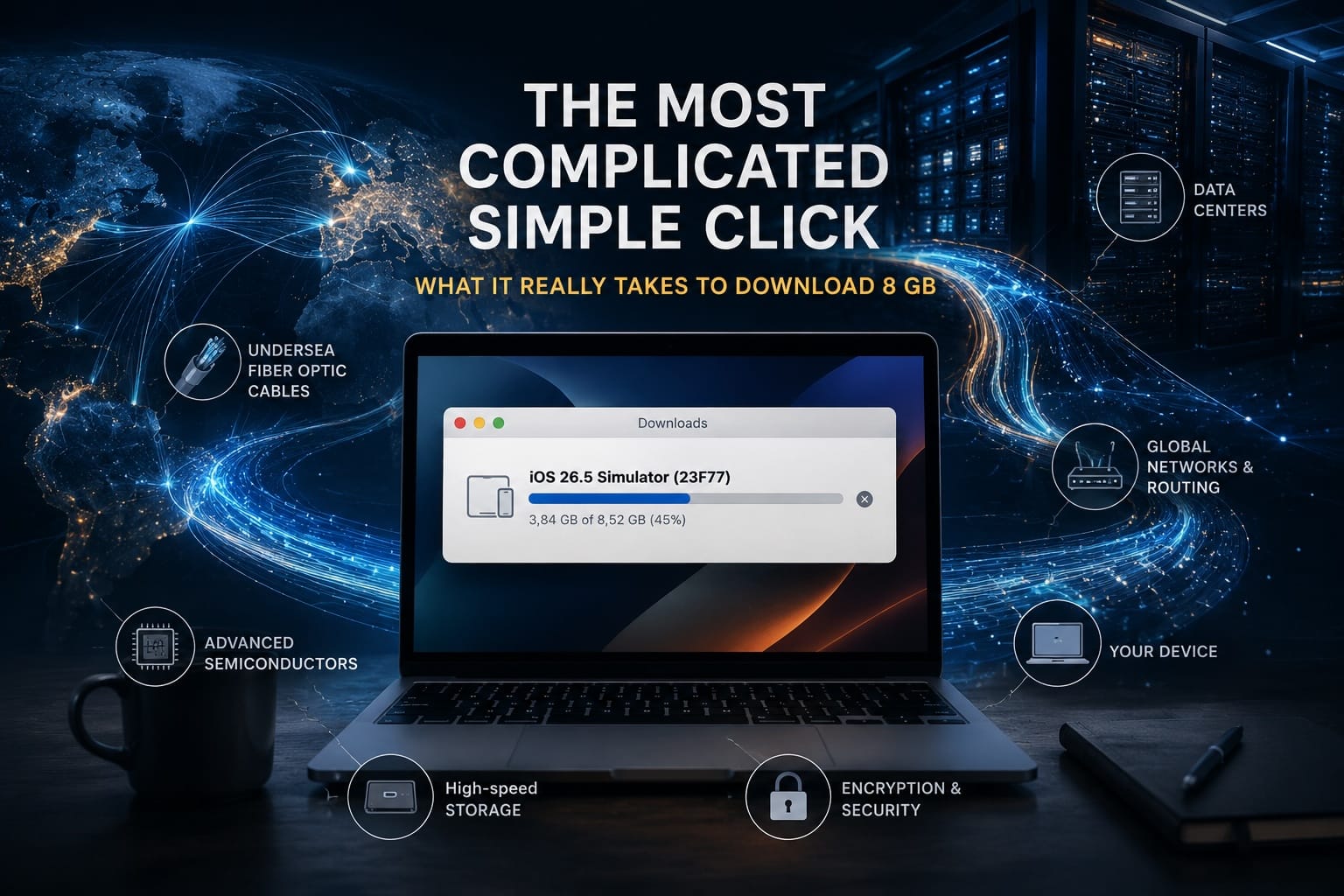
A few days ago, I found myself watching a familiar progress bar:
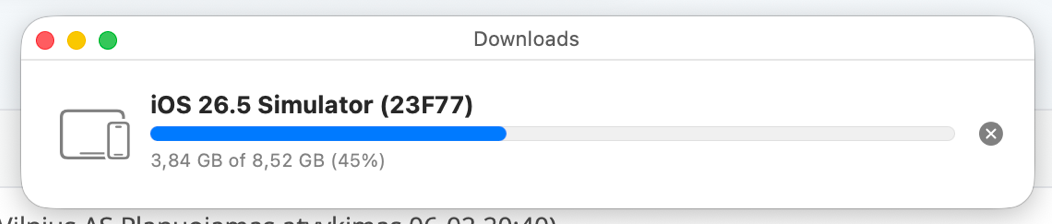
An iOS Simulator image was downloading on my Mac. Nothing unusual — just an 8.5 GB file moving at around 90 MB/s.
- A single click.
- Wait a few minutes.
- Done.
- Or so it seems.
Looking at that progress bar, I started wondering: how many technologies, inventions, companies, engineers, and decades of innovation stand behind this incredibly simple action?
The answer is almost impossible to comprehend.
What Actually Happens When You Click “Download”?
At first glance, it feels like your computer is simply receiving a file from somewhere.
In reality, a staggering chain of events begins.
The file itself might be stored in a data center hundreds or thousands of kilometers away. Maybe in Ireland. Maybe in Germany. Maybe in a distributed storage cluster spread across multiple continents.
The moment you click download:
- Your Mac sends a request.
- DNS servers translate a human-readable address into an IP address.
- Routing systems determine the best path across the Internet.
- Data starts traveling through dozens of networks owned by different companies.
- Multiple servers coordinate to deliver pieces of the file.
- Error correction systems verify every packet.
- Encryption protects the transfer.
- Storage systems retrieve the data.
- Fiber optic equipment converts electrical signals into light and back again.
And all of this happens in milliseconds!
The Journey of a Single Bit
Let’s imagine just one bit of your file.
Not the entire 8.5 GB. Just a single 0 or 1.
That bit may:
- Leave a storage device inside a server rack.
- Travel through a data center switch.
- Pass through several routers.
- Enter a fiber optic cable.
- Cross cities, countries, or even oceans.
- Reach your Internet provider.
- Travel through local infrastructure.
- Enter your home router.
- Arrive at your Mac.
- Be written onto your SSD.
This journey may happen in less than a tenth of a second.
Now multiply that by roughly 70 billion bits for an 8.5 GB download.
The Invisible Oceans of Glass
One of the most fascinating parts is the infrastructure nobody sees.
The modern Internet largely runs through fiber optic cables.

Tiny strands of glass.
That’s it.
Light pulses travel through those strands at nearly the speed of light.
Thousands of kilometers beneath oceans, there are cables connecting continents:
- Europe to North America
- North America to Asia
- Asia to Australia
- Europe to Africa
When you stream a video, open a website, or download software, there is a good chance some of your data has traveled through underwater cables resting on the ocean floor.
Human civilization literally wrapped the planet in glass.
Data Centers: The Factories of the Digital Age
Behind every download stands a data center.
Imagine enormous warehouses filled not with products, but with computers.
Thousands. Sometimes hundreds of thousands.

Rows of servers continuously:
- storing data,
- processing requests,
- balancing traffic,
- creating backups,
- monitoring failures.
The electricity consumption of large data centers rivals that of small cities.
Cooling systems operate around the clock because modern processors generate tremendous amounts of heat.
When you click “Download,” somewhere a machine wakes up and starts serving your file.
Actually, many machines.
The SSD Inside Your Laptop Is a Miracle Too
We often focus on the Internet, but the destination matters just as much.
That 8.5 GB file eventually lands on an SSD. Modern SSDs store information inside billions of microscopic memory cells. Each cell is manufactured using processes measured in nanometers.
For perspective:
- A human hair is roughly 80,000–100,000 nanometers wide.
- Modern chips are built with structures measured in single-digit nanometers.
Engineers effectively learned how to manufacture billions of tiny electronic switches with near-perfect precision.
And now we casually complain when a download takes five minutes.
The Software Stack Nobody Thinks About
The progress bar itself represents decades of software engineering:
- Operating systems.
- Network protocols.
- File systems.
- Security standards.
- Compression algorithms.
- Error correction.
- User interface design.
- Developer tools.
The download window on my screen exists because millions of developers contributed countless hours over decades.
Many of them never met each other.
Yet their work fits together perfectly enough that I can click a button and expect everything to work.
Most of the time, it does.
Twenty Years Ago
If you were downloading an 8.5 GB file twenty years ago, the experience would have been dramatically different.
A home Internet connection might have been:
- 256 Kbps
- 512 Kbps
- maybe a few Mbps if you were lucky
At 256 Kbps, downloading 8.5 GB would take
months, not minutes.
Storage was expensive. Processors were slower. Networks were less reliable. Cloud computing barely existed.
Today, we often take for granted what would have seemed almost magical in the early 2000s.
The Hidden Collaboration of Humanity
What fascinates me most is that no single company created this experience.
This simple download depends on:
- physicists discovering principles of light,
- mathematicians developing algorithms,
- engineers designing chips,
- network architects building infrastructure,
- software developers writing code,
- manufacturers producing hardware,
- construction crews laying fiber cables,
- technicians maintaining equipment.
Millions of people contributed small pieces. Over decades. Across continents. Across generations.
The Progress Bar
So next time you see a progress bar downloading a few gigabytes, pause for a moment.
You’re not just watching a file transfer.
You’re watching the result of thousands of inventions, millions of engineering decisions, and decades of human collaboration.
What looks like the simplest action on a computer screen is actually one of the most sophisticated achievements in human history.
And the most amazing part?
We’ve become so accustomed to it that we hardly notice anymore.